Authorized telemetry
The signals required for analysis, integrated within explicit access and governance boundaries.

AI-Powered Cyber Defense
Bellot helps companies understand where they are exposed, decide what matters first and build the capacity to detect and respond, using AI to accelerate analysis without removing human control.

Our operating model
Security tools produce signals. They do not automatically produce understanding. Bellot relates evidence to assets, threat behavior and operational consequences to reveal what demands attention, and what must happen next.
AI expands analytical reach. Human judgment retains authority over critical decisions.

IT infrastructure under continuous observation
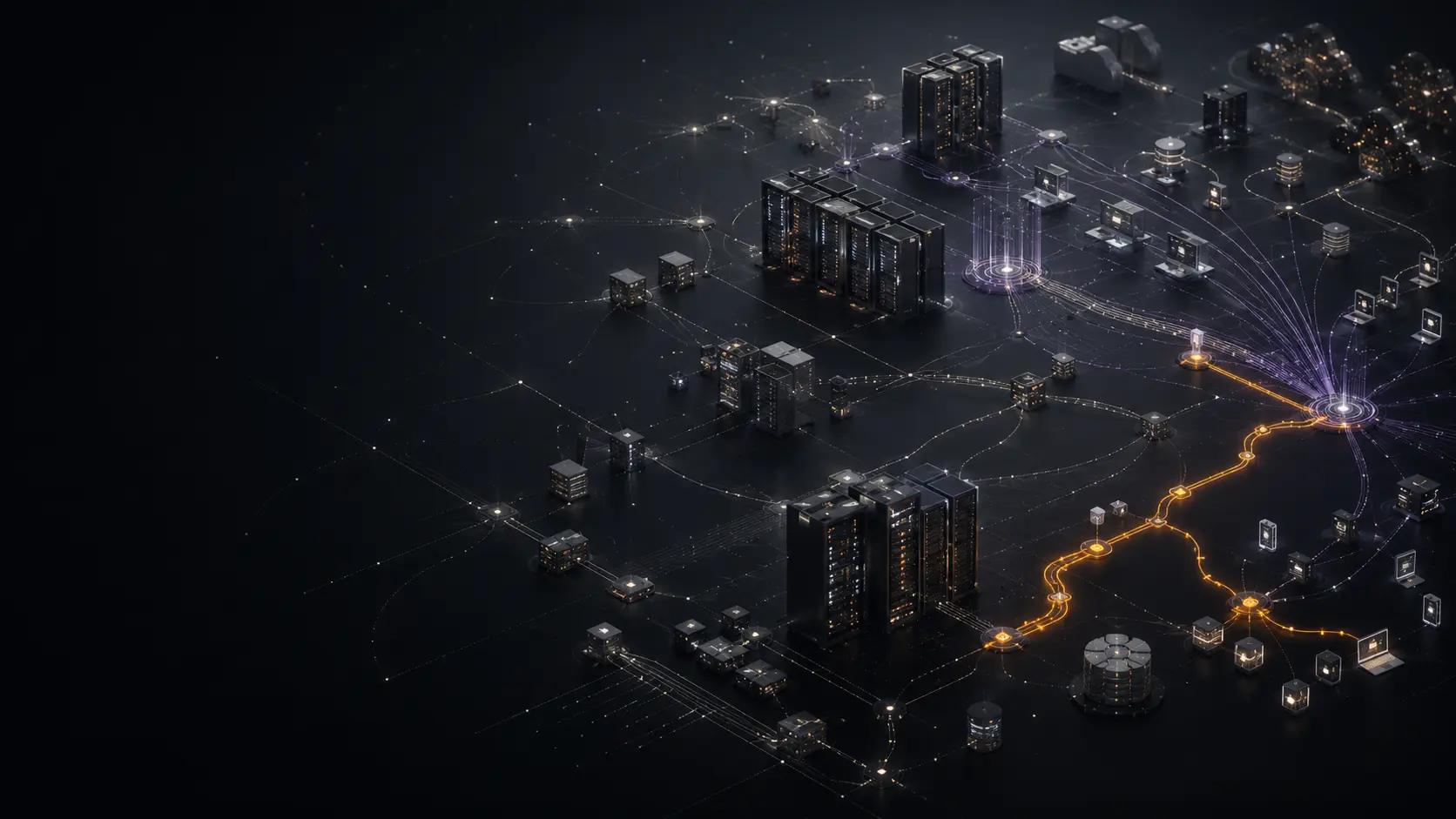
Bellot connects signals across these environments to reveal attack paths, confirm anomalous behavior and guide containment without losing sight of operational continuity.
The signals required for analysis, integrated within explicit access and governance boundaries.
Identity, asset and network behavior evaluated as one investigation, not isolated alerts.
Clear containment decisions, validation evidence and human authority over critical actions.
 Cybersecurity Intelligence Engine
Harpia relates identity, endpoint, cloud, network and threat signals to expose behavior, reconstruct attack paths and prioritize investigation.
It is not a chatbot or a generic AI wrapper. Harpia is an operational cybersecurity intelligence engine integrated through authorized telemetry, explicit policies and human-governed response.

Harpia in operation
Explore the operating stages of the intelligence engine. Each transition remains explicit, traceable and subject to the policies defined for the client environment.
Five authorized events enter with source and time preserved.
Bellot Cyber Defense
You do not need to know which cybersecurity product to buy. Start with the business problem: exposure you cannot measure, alerts you cannot interpret, access you do not control or an operation that cannot stop.
Understand where the business can be reached.
Fix first what can cause the greatest consequence.
Know who decides and how the company reacts.
Track whether exposure is actually decreasing.
We show which systems sustain the business, how an attack could reach them and what should be fixed first.
We identify forgotten assets, exposed access and relevant threats so your team fixes what can truly cause impact.
We organize signals from tools you already own to identify suspicious behavior and guide the next action.
We review accounts, privileges and cloud environments to reduce paths from a stolen credential to critical systems.
We define responsibilities, decisions and safe containment paths before pressure puts operations at risk.
We reduce exposure across IT, suppliers and industrial systems while respecting safety, availability and maintenance windows.
Industries
Bellot is designed for organizations with meaningful IT, cloud, OT or connected infrastructure, especially when internal technology teams operate without a mature dedicated cyber defense function.
Production, industrial networks and operational continuity.
Distributed systems, warehouses, fleets and supplier access.
Connected operations, remote sites and critical production windows.
IT/OT convergence, privileged access and essential services.
Data centers, service providers and high-availability environments.
Organizations where cloud, corporate IT and industrial systems intersect.
These are operating contexts Bellot is designed to support, not a claim of undisclosed clients or past projects.

Engineering behind the defense
Bellot combines technical investigation, architecture decisions and operational validation. Automation accelerates repeatable work; consequential actions remain documented, reviewable and governed.
AI-driven threat intelligence
Bellot correlates exposure, identity, network and endpoint behavior so isolated events become an explainable attack path, a defensible priority and a controlled response.
Bring authorized signals from identity, cloud, endpoint and network.
Relate infrastructure, behavior, threat context and time.
Reconstruct the attack path and the evidence behind the priority.
Guide containment while preserving operational continuity.

Evidence, not theater
Every engagement produces traceable engineering artifacts. The examples below describe the actual structure of delivery; client data and sensitive implementation details remain protected.
A non-client example showing the structure Bellot uses to relate assets, trust boundaries, evidence, confidence and operational consequence.
Assets, trust boundaries, hypotheses, supporting evidence and credible routes to operational consequence.
Architecture decisions, detection logic, acceptance criteria, runbooks and explicit control limits.
Validation record, prioritized backlog, assigned ownership and the conditions required for continued operation.
Start with the consequence
In the first conversation, we identify the systems that sustain the business, the most consequential defensive uncertainty and the right place to begin.
Schedule a technical conversation